

Autism is a complex developmental disability that affects a person’s ability to communicate and interact with others, with a wide range of behavioral, social, and language problems.
Autism usually appears during the first three years of life.
Autism is characterized by a collection of neurobehavioral, neurological, gastrointestinal and immunological dysfunctions that include a loss of eye contact, deficiencies in socialization and communication, abnormal theory of mind function, language dysfunction, restrictive, repetitive, and stereotypical behaviors, food allergies, constipation, yeast infections and other behavioral and medical conditions. Autism is called a “spectrum disorder” since it affects individuals differently and to varying degrees.
It is estimated that one in every 150 American children has some degree of autism with males being affected three to four times more frequently than females. Autism Spectrum Disorders (ASD) are complicated conditions that may require an integrative treatment protocol involving many factors including behavioral and social therapy, pharmacotherapy, environmental control, dietary supplements, nutritional, alternative and biomedical therapies. Many are sick with gastrointestinal, immunologic, and metabolic problems that significantly affect their behavior and their physical and emotional health. Treating the medical problems often leads to improvement in clinical signs and symptoms and, in some cases, to recovery.
Causes of Autism

The fundamental cause of Autism, based in our experience, is severe intestinal flora imbalances resulting into immune imbalances mainly due to gastrointestinal infections, antibiotics and vaccinations that in turn affect the brain. We have daily phone and e-mail contacts with parents of ASD children where parents detail causes and symptoms of Autism and treatments they undertake for their children. Our evaluation of causes of Autism is as follows.
Autism usually appears during the first three years of life. The reason is, and it is well documented, that between the ages of 0-3, the intestinal microflora of a child is not well established yet. The same can be said about the brain and nervous system. They are in a stage of formation and are fragile. During this time, if a lot of antibiotics and/or vaccinations are given, and if the immune system of a child is somewhat low, the intestinal microflora being fragile is affected negatively. As a result a toxic condition is produced in the gut that will affect the brain and the nervous system to various extents. The more toxicity in the gut the more the effect on the brain. As a result, the majority of children with Autism reveal abnormal gastrointestinal symptoms including food allergies, yeast infections, constipation.
Factors affecting Gut/Brain/Immune dysfunction and Autism are indicated in Fig. 1. These factors result into at least two types of ASD with regard to disease development: abnormal cognitive development evident from birth (classical autism); and in the majority cases developmental regression, usually between 18-36 months of age, following apparent normal development (regressive autism).
Gut/Brain/Immune Dysfunction and Autism

It is very important to understand the direct relationship between the gut and brain, especially during the first three years of life, when both are in a stage of formation. The above factors make the immune system of each chbild different and unique. Therefore physicians, especially pediatricians, should not treat all children alike, but on a case by case basis after careful evaluation with the parents. A detailed history should be taken that can determine, at least qualitatively, the immune system of each child. Hence the standard vaccination schedule can not be applicable, if the above factors are not evaluated and taken into consideration properly.
Gut-Brain-Immune Axis
The gastrointestinal tract is a complex ecosystem in which there is a delicate balance between the intestinal microflora and the host. A healthy gastrointestinal tract should contain a high percentage of Lactobacilli and Bifidobacteria beneficial bacteria to prevent the over colonization of disease causing pathogenic micro-organisms such as E. Coli, Clostridia, Salmonella and Candida.
Bidirectional interactions between the brain and intestinal microflora might have an important role in modulating gut and brain function and may be involved in the modulation of emotions, pain perception, mucosal immune activity and general well-being. The reduction of Lactobacilli and Bifidobacteria and overgrowth of pathogenic bacteria will be stressful to this brain/gut interactions especially for infants aged 0-3 producing neurological and immune imbalances and affecting their development. The neurological and immune systems are inextricably intertwined beginning in the embryonic stage of life. Disruption of the bidirectional interactions between the intestinal microflora and the nervous system may be involved in the pathophysiology of acute and chronic gastrointestinal and neurological disease states. Fig. 2 is a representation of such interaction.

Abbreviations: ANS, autonomic nervous system; CNS, central nervous system; EMS, emotional motor system; GI, gastrointestinal; HPA, hypothalamus–pituitary–adrenal. Fig. 2 Source: Rhee, S. H. et al. Nat. Rev. Gastroenterol. Hepatol. 6, 306–314 (2009)
The following you tube video is a good presentation about the Gut-Brain relationship.
Probiotic Supplements For Autism
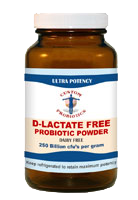 D-Lactate is a by-product of probiotic fermentation that may produce neurological problems. Our D-Lactate Free Probiotic powder formulation is very high in potency at 250 billion cfu’s per gram. It contains L. Salivarius, L. Rhamnosus, B. Bifidum, B. Infantis and B. Longum. It is dairy free, hypoallergenicand does not contain any artificial colors, flavors, sugar, casein, gluten, soy or FOS. Children with ASD have used our D-Lactate Free formulation successfully worldwide. Daily probiotics usage is recommended and dosage varies from person to person. Dosage depends on the age of the child, extent of intestinal flora imbalances due to candida or other pathogenic bacteria and the response of each child to it.
Probiotics and Autism
Probiotics are defined as “live microorganisms which, when administered in adequate amounts, confer a health benefit to the host”. They possess the ability to transiently colonize the GI tract, increase the concentration of beneficial microbes, and thereby create a balance in the gut microbiota to the ultimate benefit of the host, in a natural and safe way.
Potential or known mechanisms whereby probiotic bacteria might impact on the microbiota include:
- competition for dietary ingredients as growth substrates
- bioconversion of, for example, sugars into fermentation products with inhibitory properties
- production of growth substrates
- direct effect on pathogens
- competitive exclusion for binding sites
- improved barrier function
- reduction of inflammation, thus altering intestinal properties for colonization and persistence within, and (8) stimulation of innate immune response.
Probiotics can therefore be useful for children with ASD. This can be done by protecting their digestive and immune systems by using probiotics at appropriate dosages prior, during and after any intervention, such as antibiotics or vaccinations, that affect negatively the intestinal microflora and immune system of the mother and infant, as indicated in Fig. 1. Choosing the correct probiotic formulation and dosages are considerations that also must be understood and followed by pediatricians and parents alike.
To conclude, it is important to understand the causes of Autism and take steps to prevent or reduce the risk from its happening. While probiotics will not cure Autism after the fact, modifications of gut function using proper probiotic dosages can improve symptoms to various extents, depending how severe the brain is affected. Our probiotics have been used by Health Care Professionals and parents of children with ASD around the world for the past 8 years. Our clients have also seen improvements using various biomedical treatments such as gluten, casein and sugar free diet, chelation, antifungals, DAN protocol, methyl B-12 shots, speech therapy and social groups.
D-Lactate Free Probiotic Dosage Suggestions
Dosage of probiotics used per day is very important and it varies from person to person. Dosage depends on the age of the child, extent of intestinal flora imbalances dues to candida or other pathogenic bacteria. Therefore our strategy is to start at a low dosage and gradually go up to a dosage that gives optimum results.
We supply child scoops and adult scoops. Each child scoops measures 0.1 grams of our four strain D-Lactate Free probiotic powder which is equivalent to about 25 billion cfu's. Each adult scoop measures about 0.8 grams equivalent to about 200 billion cfu's of probiotic bacteria. The greater the bacterial imbalance in the digestive system, the higher the dosage required for positive and measurable results. However the appropriate dosage of probiotics needs to be determined individually. If you get ANY negative reactions as you go up in dosage, then that means you have used too much. Stop the probiotics for one day and go back to the previous dosage.
We suggest taking probiotics first thing in the morning and/or at bedtime, with water.
For very young children ages 1-4, use the child scoop.
Below are our dosage suggestions:
- Start with one child scoop (0.1 gram) of the probiotic powder first thing in the morning on empty stomach.
- Dissolve the powder in a glass of dechlorinated water and drink it.
- Stay at this dosage for about 3 days.
- If you do not see any improvement in symptoms, you can raise the dosage to one scoop in the morning and one scoop at bedtime.
- After 3-5 days, if you are not happy with the results, you can go up in dosage to 2 scoops AM and 2 scoops PM a day.
- You can go to higher dosages as well, IF need be.
- Have your child’s breakfast after about 30 minutes from the time of taking probiotics.
Please click here for Dosage Suggestions
NOTE:
Every digestive system is unique like a fingerprint. You have to find the dosage that best suits YOUR child. It may be one, two, three or even six scoops a day depending on child’s age and results obtained. Thus gradual increase in dosage is recommended. Please do not hesitate to contact us for further information or assistance.
STORAGE: Our probiotic formulations must be refrigerated to maintain maximum potency. You can store our D-Lactate free probiotics powders in the freezer, since our probiotics are freeze dried. You can wash and dry the scoops before usage. You can also travel with our probiotic supplements unrefrigerated for two weeks with very minimal bacterial count reduction.
Preventing Autism | What the Parents Say
Autism Survey Questionnaire
| Dear parents,
We are conducting a survey regarding the causes of Autism and treatments that work.
Below are three fundamental questions. We would appreciate if you, parents of children with autism spectrum disorder, could give us your feedback. We will collect the data and present it as a statistical data at a later date. Many thanks for your cooperation.
Fill out my online form.
|